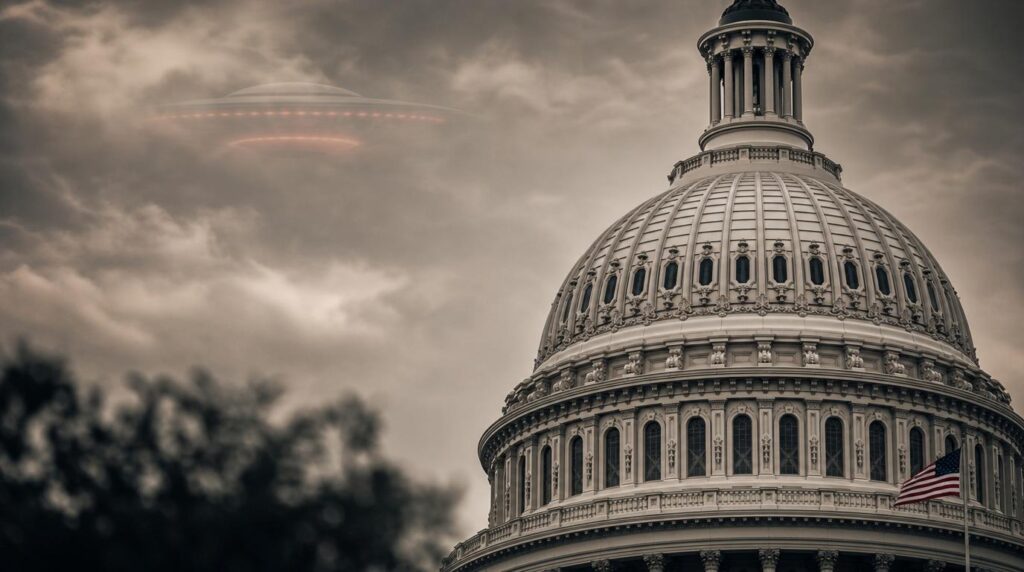
What NHI Stands For
NHI stands for Non-Human Intelligence. The acronym appears in U.S. law as of the FY2024 National Defense Authorization Act, in Congressional testimony from former Air Force intelligence officer David Grusch, and across documents from the Pentagon’s All-domain Anomaly Resolution Office (AARO).
It is not the casual phrasing of a UFO blogger. It is the working term of the U.S. federal government.
The shift from “alien” or “extraterrestrial” to “Non-Human Intelligence” happened with deliberate intent. The new term keeps the door open in a way the old terms did not.
Where It Appears in U.S. Law
The clearest legal anchor is the FY2024 National Defense Authorization Act, signed December 22, 2023. The act incorporates revised UAP language from Senate Majority Leader Chuck Schumer’s UAP Disclosure Act, including a formal definition of “Non-Human Intelligence” in the context of UAP retrieval programs and disclosure mandates for any biologics or technologies of unknown origin.
The Schumer-Rounds UAP Disclosure Act of 2023 went further in its original Senate-passed form, including specific provisions for eminent domain over recovered NHI materials held by private contractors. Much of that language was stripped in conference committee — over the objections of Schumer himself, who called the dilution “a tragedy.”
But the term “Non-Human Intelligence” survived. And it now lives in federal law.
Why “Alien” Is No Longer the Word
The reason for the shift is not branding. It’s epistemology.
“Alien” implies origin. Specifically: from another planet. Saying “alien” commits you to the extraterrestrial hypothesis (ETH) — that whatever is being observed came from somewhere else in physical space.
“Non-Human Intelligence” makes no such commitment. It admits at least five distinct possibilities the government is reportedly taking seriously:
- Extraterrestrial — Conventional ETs from elsewhere in our universe.
- Interdimensional — Entities from a parallel dimension or higher-dimensional reality, favored by researchers like Jacques Vallée since the 1960s.
- Time-displaced — Future humans or human-adjacent beings.
- Cryptoterrestrial — Indigenous to Earth but hidden — subterranean, undersea, or evolutionary divergent.
- Artificial / synthetic — Advanced AI or biomechanical constructs without biological origin in the human sense.
The Pentagon is not endorsing any of these. But the term “NHI” preserves the possibility of all of them. “Alien” does not.
What the Pentagon Has Actually Said
AARO, established in 2022 under the Office of the Under Secretary of Defense for Intelligence & Security, publishes a small but growing public record. Its Historical Record Report Volume I, released March 2024, used “UAP” throughout and described its mandate as covering objects that “cannot be readily identified as having natural or human-made origin.”
That last phrase is the operative one. “Non-human” is the residual category — what is left over when natural and human-made are both ruled out.
David Grusch, testifying under oath before the House Oversight Committee on July 26, 2023, used “Non-Human Intelligence” repeatedly. He stated that the U.S. government has been in possession of “non-human biologics” and “intact and partially intact craft of non-human origin” for decades. Grusch’s claims have not been independently verified — but the fact that they were made under oath, on the Congressional record, by a credentialed intelligence officer, is itself an event.
What This Means Going Forward
The term “NHI” is what disclosure looks like in motion. It is the bureaucratic language of an intelligence community that is preparing the public — slowly, with extreme procedural caution — for an admission it has not yet made.
Watch the term. When you see “NHI” in a future report from AARO, the Office of the Director of National Intelligence (ODNI), or an NDAA amendment, you are watching the disclosure conversation evolve in real time.
The casual reader sees “Non-Human Intelligence” and reads “alien.” That’s the public-facing simplification. The structure of the term itself tells a different story: whoever wrote it is preserving every option but the one that says the phenomenon is nothing at all.